
Hvítserkur Basalt Stack
Hvítserkur is a 15-metre basalt sea stack standing in the shallow waters of Húnaflói Bay on the eastern shore of the Vatnsnes Peninsula in Northwest Iceland. Its two arched legs and tapered body have inspired comparisons to a dragon drinking from the sea, a rhinoceros, and an elephant, depending on the viewing angle and the state of the tide. The name means white shirt in Icelandic, a reference to the coating of seabird guano that covers the dark basalt in summer. Icelandic folklore holds that Hvítserkur is a troll from the Westfjords who was turned to stone by the rising sun while hurling rocks at the Þingeyraklaustur monastery, whose bells had driven him to fury.
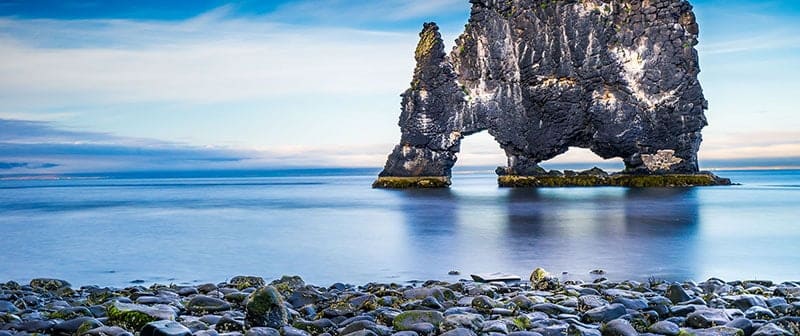
A 15-Metre Basalt Troll, Frozen in Húnaflói Bay While Attacking a Monastery
Hvítserkur formed as a basalt volcanic plug, the hardened core of a lava fissure that pushed upward through surrounding softer rock. Over thousands of years the surrounding material eroded away under the attack of Atlantic waves, wind, and salt, leaving only the resistant basalt standing. The two arched openings at its base were likely formed along weaknesses in the original lava fissure and further carved by the sea. The rock stands 15 metres tall and its silhouette changes considerably with the tides: at high water the legs are submerged and the formation appears as a solid column; at low water the arches are exposed and the full animal-like profile is revealed. Concrete reinforcements have been added to the base of the rock in recent decades to slow the ongoing erosion and protect it from collapse.
The Icelandic folklore attached to Hvítserkur follows the same pattern as Reynisdrangar and several other striking rock formations around the country: a troll caught outdoors at sunrise and turned to stone. Here, the story holds that a troll from the Strandir coast in the Westfjords was so enraged by the sound of the bells at the Þingeyraklaustur monastery that he marched across Húnaflói Bay to destroy them, throwing rocks as he went. Daylight caught him in the water before he reached his target, and he stands there still, mid-throw. The monastery at Þingeyrar is a real and ancient site, founded in 1133, and the connection between the folklore and the actual landscape gives the story an unusual degree of specificity.
Hvítserkur is reached via Route 711 along the eastern shore of the Vatnsnes Peninsula, turning off the Ring Road north of Blönduós. The drive from the Ring Road takes around 30 minutes on a mostly gravel surface. A car park above the rock gives access to a viewing platform with a direct sightline down to the formation, and a steep stepped path leads to the black sand beach below for closer views at low tide. The Vatnsnes Peninsula is also one of the best seal-watching areas in Iceland, with harbour seals regularly visible on rocks along the coast and at the beach near the formation. The site is free to visit year-round. From Reykjavík the drive takes approximately three hours along the Ring Road.

