
Reynisdrangar Sea Stacks
Reynisdrangar are three dramatic basalt sea stacks rising up to 66 metres from the North Atlantic just off Reynisfjara, Iceland's famous black sand beach near Vík. They are what remains of ancient volcanic rock gradually separated from Reynisfjall mountain by millennia of erosion. According to Icelandic folklore, the stacks are trolls turned to stone by daylight as they tried to drag ships ashore, a legend so embedded in local culture that the shape of the stacks appears on signage throughout the village of Vík.
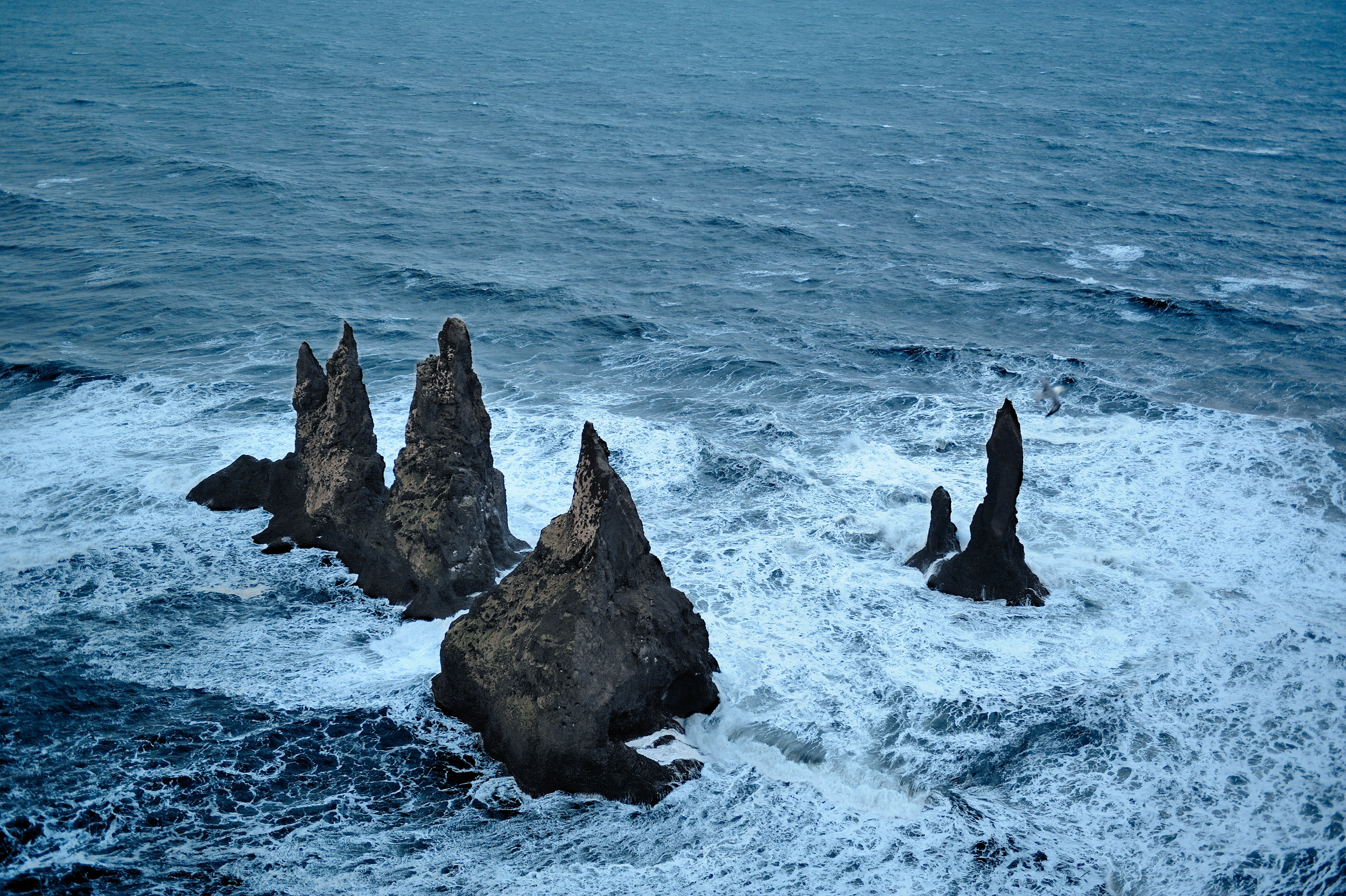
Three Basalt Pillars Rising from the South Coast, Forged in Folklore and Volcanic Fire
Reynisdrangar formed during volcanic activity estimated at between 5 and 7 million years ago. The stacks were originally part of Reynisfjall, the mountain that backs Reynisfjara beach, but the relentless action of the North Atlantic gradually carved them away from the headland and left them standing offshore. The tallest of the three, known as Langsamur, reaches 66 metres above the waterline. They are composed of the same columnar basalt found in the cave and cliff walls along the beach, the characteristic hexagonal formations that result from lava cooling slowly and evenly from the outside in.
The stacks are a significant seabird colony. Puffins nest on the upper ledges from May through August, alongside fulmars, Arctic terns, guillemots, and razorbills. Watching the birds wheel around the stacks against the backdrop of the black beach and the brooding outline of Reynisfjall is one of the most striking wildlife spectacles on the South Coast. The trolls-to-stone legend attached to Reynisdrangar is one of the most retold pieces of Icelandic folklore: two versions exist, one in which the trolls were trying to pull ships onto the shore when dawn caught them, and another in which a wronged husband lured the trolls out into daylight as an act of revenge. The stacks appeared in the HBO series Game of Thrones, filmed here during the show's depiction of the lands north of the Wall.
Reynisdrangar are best viewed from Reynisfjara beach or from the clifftops above Dyrhólaey, roughly 10 kilometres to the west. Note that Reynisfjara beach experienced significant erosion in early 2026 and access conditions may have changed; check current status before visiting. The stacks can also be seen clearly from the village of Vík, a short drive east along the Ring Road. There is no fee to view them. The area is about 180 kilometres from Reykjavík, roughly a 2.5-hour drive southeast along Route 1.

